Available now · part of the Team plan
Focus areas and actions
Results matter only when something changes. The group picks at most two scales from its results and agrees actions for each. Every action has an owner and a due date, and nobody sets a target on a survey score.
What it brings
- For you
Clear about what is yours
- Your open actions wait for you on Home and on Me.
- Each action has a due date, so nothing drifts without notice.
- You mark your own actions done, on a phone too.
- For the leadership group
Two things at a time
- At most two focus areas, so effort is not spread thin.
- Each one names the round, level and agreement it came from.
- Any member can add an action, and give it to any member.
- For the organisation
Results that lead to change
- A written record of what the leadership group chose to work on.
- Actions with owners and dates, not good intentions.
- No target on a survey score, so answers stay honest.
How it works
Focus areas from the results
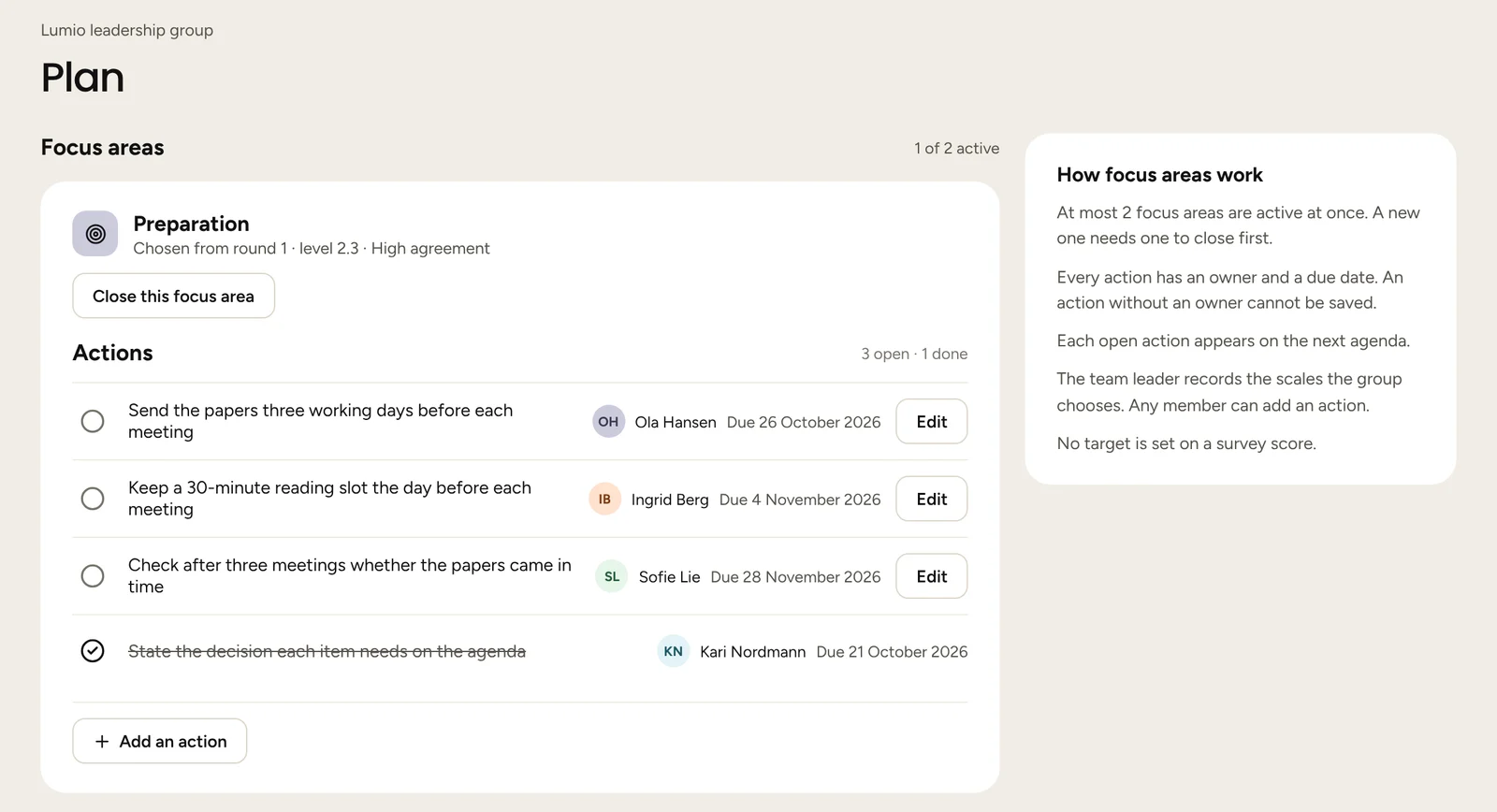
The group chooses which scales to work on, and the leader records the choice. At most two are active at once. Each focus area says which round it came from, with the scale’s level and agreement there.
- A focus area is one of the 21 scales, never an outcome.
- Closing one opens a place for the next. Its actions stay.
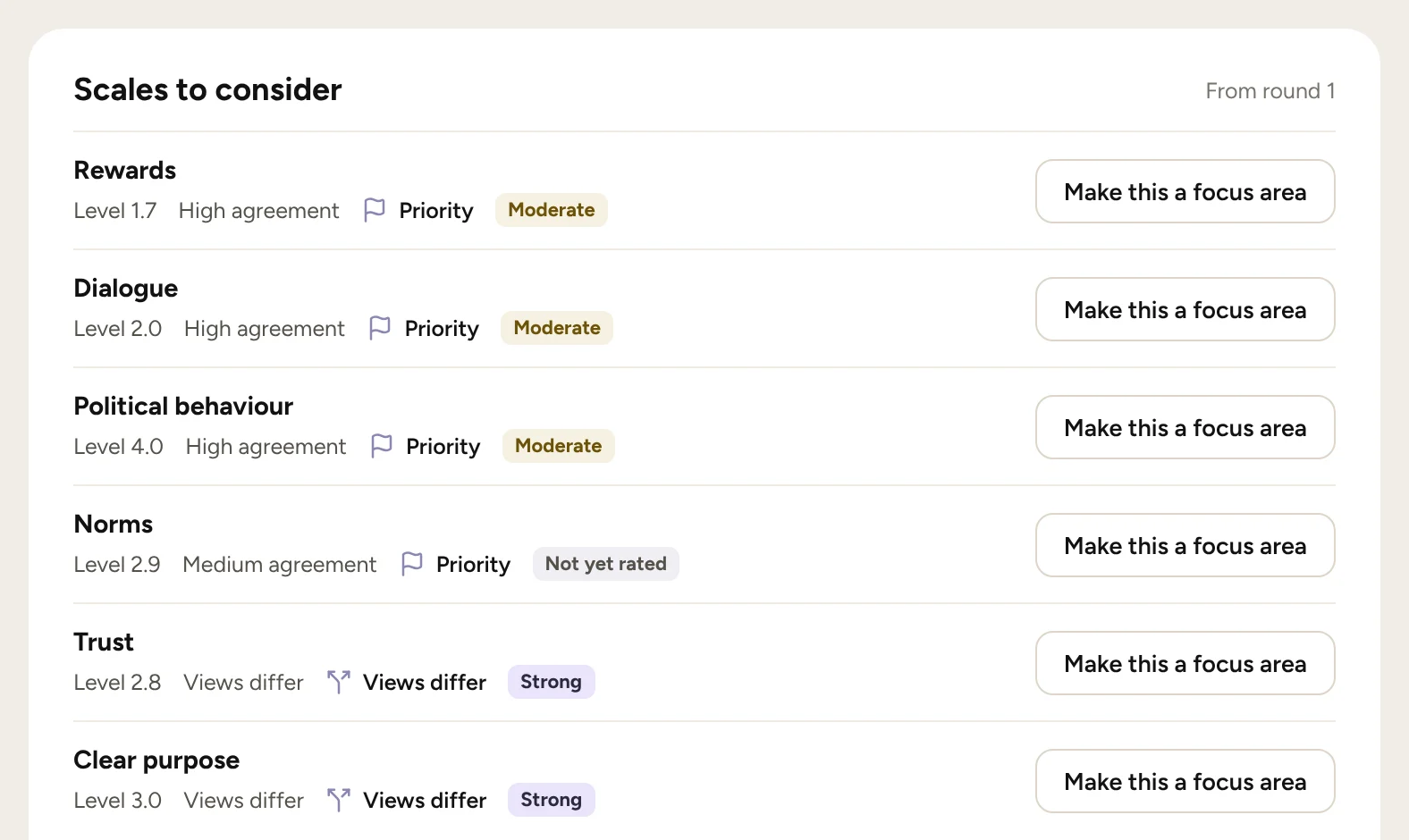
Scales to consider
While a place is open, the Plan page lists scales from the newest released round. Priorities come first, then the scales where views differ, then those to watch.
- Up to six scales, each with its level, agreement and standing.
- Each shows how strong the research behind that scale is.
Actions with an owner and a date
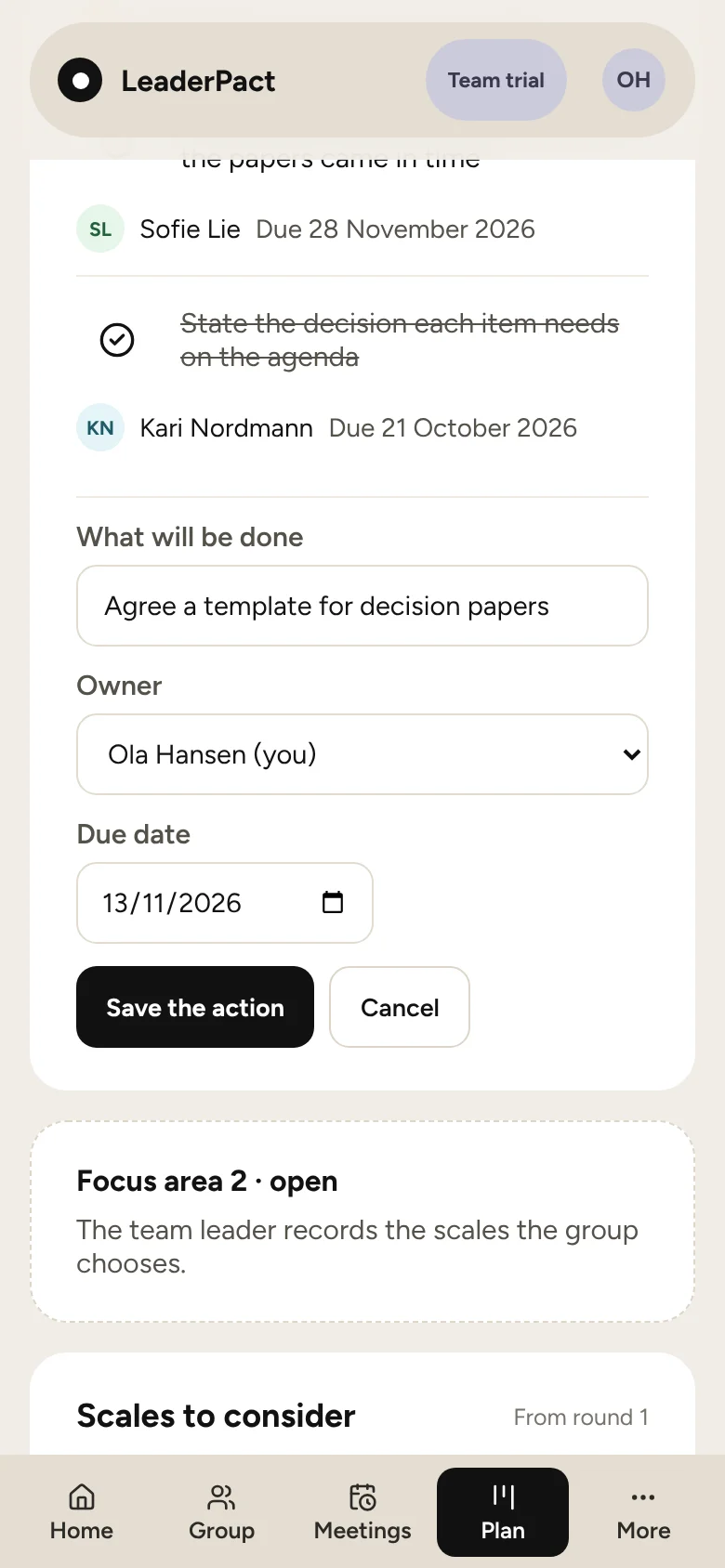
Any member adds an action to an active focus area. It needs what will be done, an owner who is in the group, and a due date. Without an owner, it cannot be saved.
- The owner or the leader marks it done, or changes it.
- Done actions stay on the page, struck through, as a record.
From results to change
Two focus areas at a time
- 1
- 2
- 3
- 4
Reading results together comes before choosing what to work on. The article on how to assess a leadership team covers how to do it.
Every open action appears on the next meeting’s agenda, beside its items. Meetings shows how, and pulses follow the focus areas between two Full diagnostics.
Questions and answers
- Why at most two focus areas?
- Two at a time keeps the group’s effort on what it chose, not spread across many scales. Closing one opens a place for another.
- Who chooses a focus area?
- The group chooses together, and the team leader records it. Any member can add actions to an active focus area.
- Can an action have no owner?
- No. Every action has an owner who is a current member of the group, and a due date. An action without an owner cannot be saved.
- Does a focus area set a target score?
- No. A focus area holds no number of its own. The next round of the Full diagnostic shows how the scale has changed.
- How does a group get focus areas?
- Focus areas and actions are part of the Team plan, with the Full diagnostic. A group’s leader can start a 14-day trial in the app, with no billing details.
More of the platform
- Leadership Team ScanTwelve questions in three minutes, and one link for the group.See how it works
- Team viewLevel and agreement per theme, for the whole group at once.See how it works
- Leader ProfileA private Big Five profile, shared only if you choose.See how it works
- Charter and membersPurpose, team tasks and working agreements, with versions.See how it works
- Full diagnostic72 statements across 21 scales and 3 outcomes, with results in three depths.See how it works
- MeetingsAgendas with outcomes and team tasks, the live meeting and its summary.See how it works
- PulsesAt most ten questions every few weeks, with change shown from 0.6.See how it works
Read next
- How to assess a leadership teamWhat to measure in a leadership team, which methods to use, how to write good survey questions, and how to keep answers anonymous.Read the article
- Leadership team meeting agenda: how to build one that worksHow to build a leadership team meeting agenda: item types, desired outcomes, owners, time boxes, pre-reads and typical topics, with an example.Read the article