Available now · part of the Team plan
Pulses
Between two Full diagnostics, a pulse shows whether the work is moving. It asks at most ten questions every few weeks: your focus areas, your working agreements and a few rotating scales.
What it brings
- For you
A few minutes now and then
- At most ten questions, answered anonymously.
- It asks about what the group chose to work on.
- You see the same result as everyone else.
- For the leadership group
A check on its own promises
- One question for each working agreement in the charter.
- Focus areas measured with the same core items as before.
- Change only when it is larger than normal variation.
- For the organisation
Progress you can follow
- A regular reading between two Full diagnostics.
- The leader sets the rhythm, from two to eight weeks.
- No target on a score, so the answers stay honest.
How it works
The rhythm and the next pulse
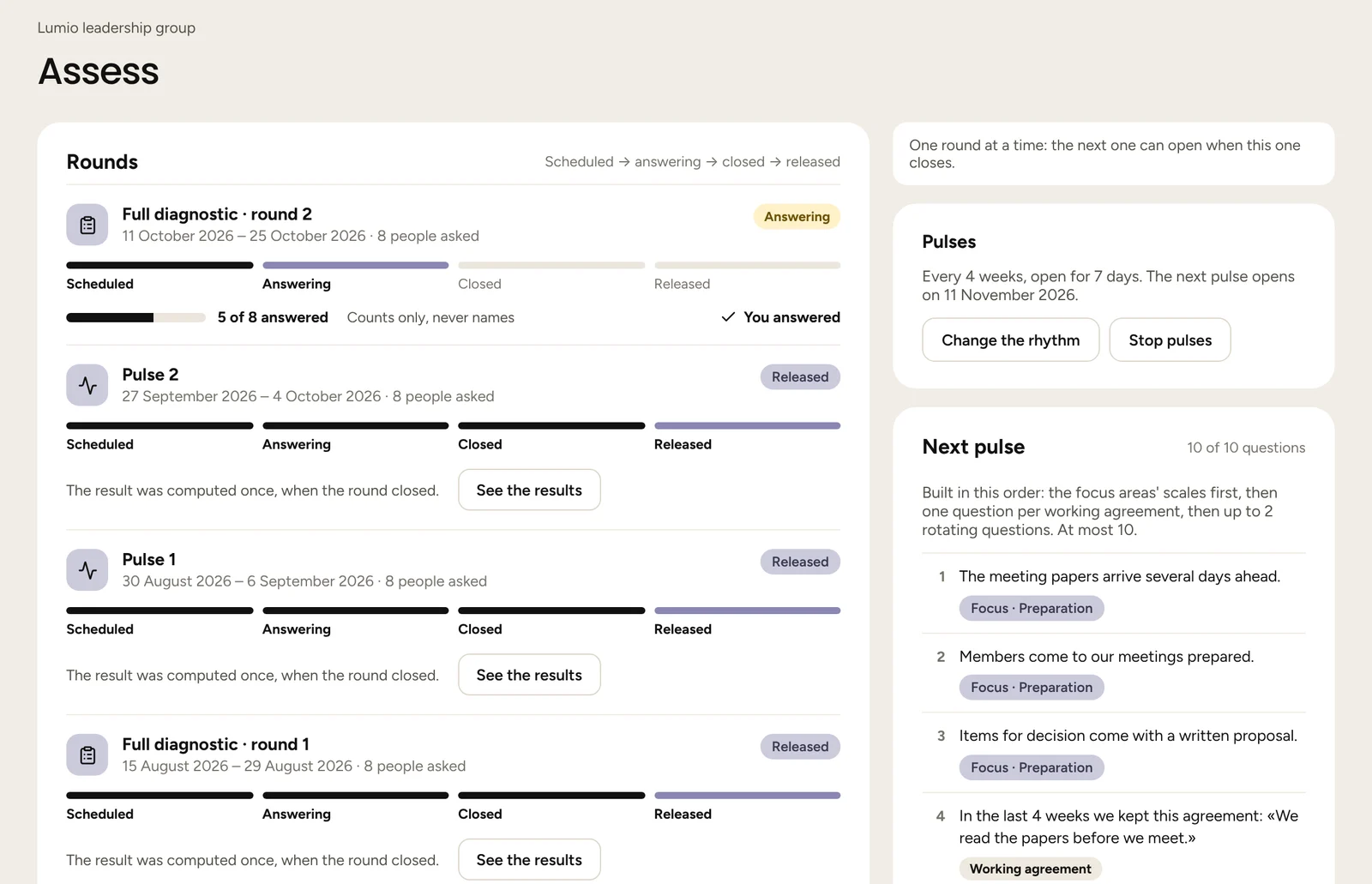
The leader starts pulses and sets the rhythm. Each pulse opens on its date and stays open for three to fourteen days. The Assess page shows what the next pulse will ask.
- Pulses sit beside the Full diagnostic’s rounds, one round at a time.
- A pulse due while another round is answering is skipped, not queued.
The result, with change
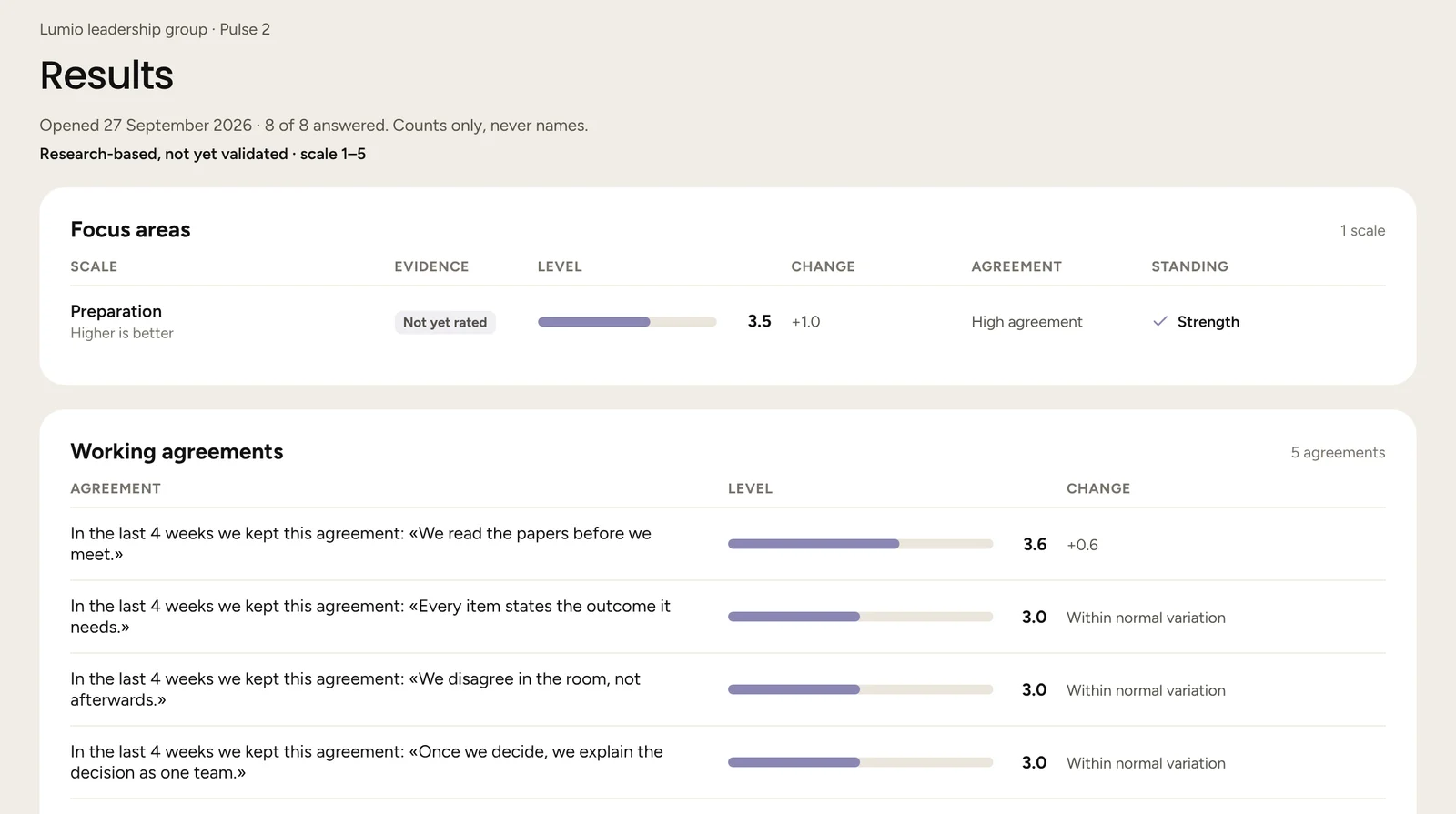
When a pulse closes, everyone in the group sees its result. Each focus area shows its level, agreement and standing. Each working agreement shows how well the group kept it.
- Change compares with the last pulse that asked the same question.
- It shows from 0.6 points. A smaller move reads as normal variation.
How a pulse is built
- 1
Focus areas first
The core items of each active focus area’s scale, in the order the areas were chosen.
- 2
Then the agreements
One question for each working agreement in the charter in force.
- 3
Then rotating items
Up to two items from other scales, those asked longest ago first. At most ten questions in all.
The Full diagnostic gives the full reading. Pulses follow the focus areas the group chose from it.
Questions and answers
- How often does a pulse run?
- Every two to eight weeks, as the leader sets it. Each pulse stays open for three to fourteen days.
- What does a pulse ask?
- At most ten questions: the focus areas’ core items, one question per working agreement, then up to two rotating items.
- When does a pulse show change?
- When a level moves by 0.6 points or more since the last pulse that asked the same question.
- Can a pulse and a diagnostic run at once?
- No. One round runs at a time, so a pulse due while a diagnostic is answering is skipped.
- How does a group get pulses?
- Pulses are part of the Team plan. A group’s leader can start a 14-day trial in the app, with no billing details.
More of the platform
- Leadership Team ScanTwelve questions in three minutes, and one link for the group.See how it works
- Team viewLevel and agreement per theme, for the whole group at once.See how it works
- Leader ProfileA private Big Five profile, shared only if you choose.See how it works
- Charter and membersPurpose, team tasks and working agreements, with versions.See how it works
- Full diagnostic72 statements across 21 scales and 3 outcomes, with results in three depths.See how it works
- Focus areas and actionsTwo scales at a time, with actions that have an owner and a date.See how it works
- MeetingsAgendas with outcomes and team tasks, the live meeting and its summary.See how it works
Read next
- How to assess a leadership teamWhat to measure in a leadership team, which methods to use, how to write good survey questions, and how to keep answers anonymous.Read the article
- Leadership team effectiveness: what makes a leadership team effective?Leadership team effectiveness explained: what research links to it, five models compared, the warning signs and how to measure it in your team.Read the article