Available now · free for one group
The team view
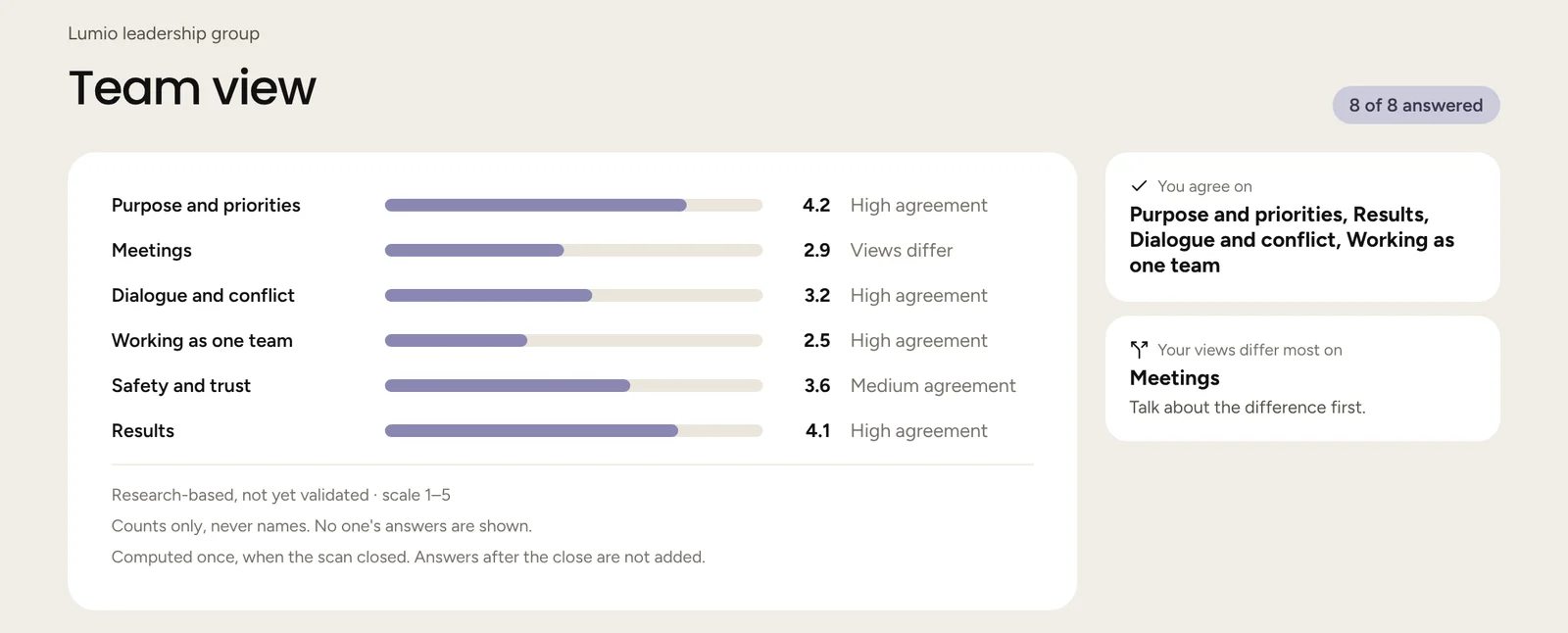
When the scan closes, the whole group sees the same picture at the same moment. Each of six themes has a level and an agreement label. It shows where you agree and where views differ, and never one person’s answers.
What it brings
- For you
Your view beside the group’s
- See whether the group reads the team the way you do.
- Know that no one can see your own answers.
- Come to the meeting with the same picture as everyone else.
- For the leadership group
A shared picture to talk about
- Level and agreement per theme, for everyone at once.
- What you agree on, and where views differ most.
- A conversation about the team, not about who said what.
- For the organisation
Early signs, without names
- Shows where the leadership group is aligned, and where it is not.
- Points to the themes worth work, from the group’s own answers.
- Answers stay anonymous, so the signal stays honest.
How it works
Level and agreement, side by side
Each theme shows the group’s level on a scale of 1 to 5, and an agreement label: high, medium, or views differ. Both are computed once, when the scan closes.
- “You agree on” lists the themes with high agreement.
- “Your views differ most on” names where to talk first.
On the group’s Home
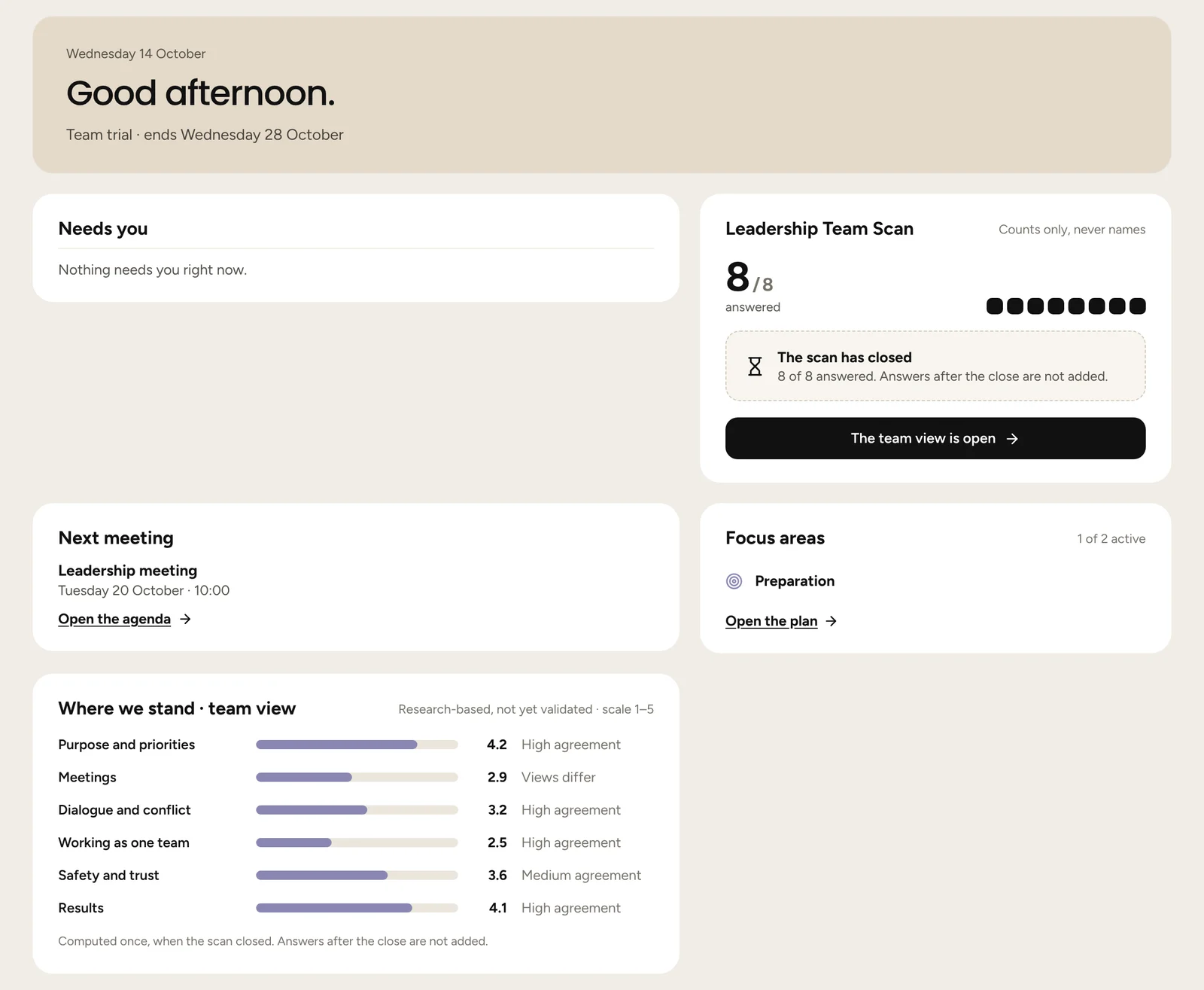
Once it opens, the team view sits on Home for every member, beside the scan’s count and a list of what needs them.
Why agreement matters
An average hides a split. A team that averages 3 may all agree on 3, or be divided between 1 and 5. The second needs a different conversation, so every theme carries an agreement label as well as a level. How to assess a leadership team explains the research behind it.
Team A: everyone answered 3Average 3.0
Answers: 3, 3, 3, 3, 3, 3Team B: three answered 1 and three answered 5Average 3.0
Answers: 1, 1, 1, 5, 5, 5
1 Strongly disagree5 Strongly agree
Three ways a scan can end
- 1
Four or more answers
The team view opens for everyone at the same moment, computed once.
- 2
Fewer than four at the close
The scan gets one extension of seven days, for more answers.
- 3
Still fewer than four
No team view is made, and the answers are deleted.
Questions and answers
- When does the team view open?
- When everyone has answered, or when the scan closes after seven days, whichever comes first. Everyone sees it at the same moment.
- Does the leader see more than the members?
- No. The leader and the members see the same team view. No one sees anyone’s answers, a lowest or highest score, or a breakdown by person.
- Do late answers change the result?
- No. The result is computed once, at the close, and answers after it are not added. A new scan gives a new result.
- What does “views differ” mean?
- That answers on a theme are spread widely across the group. It is a prompt to talk about why, not a verdict on the team.
More of the platform
- Leadership Team ScanTwelve questions in three minutes, and one link for the group.See how it works
- Leader ProfileA private Big Five profile, shared only if you choose.See how it works
- Charter and membersPurpose, team tasks and working agreements, with versions.See how it works
- Full diagnostic72 statements across 21 scales and 3 outcomes, with results in three depths.See how it works
- Focus areas and actionsTwo scales at a time, with actions that have an owner and a date.See how it works
- MeetingsAgendas with outcomes and team tasks, the live meeting and its summary.See how it works
- PulsesAt most ten questions every few weeks, with change shown from 0.6.See how it works
Read next
- How to assess a leadership teamWhat to measure in a leadership team, which methods to use, how to write good survey questions, and how to keep answers anonymous.Read the article
- Psychological safety in leadership teamsWhat psychological safety is and is not, why it is harder to build in a leadership team, and what the leader can do.Read the article